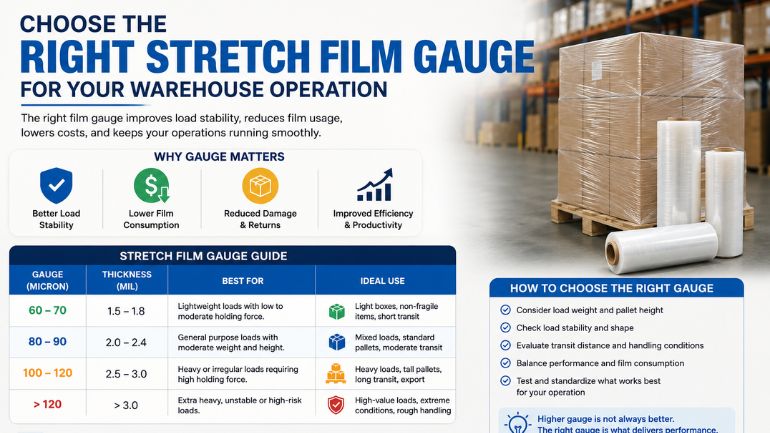
How to choose the right stretch film gauge for your warehouse operation
Stretch film looks simple. A roll of plastic wrap, a pallet, done. But pick the wrong gauge or formulation and you’ll spend the next quarter dealing with torn loads, product damage claims, and operators complaining that the film breaks mid-wrap. Getting this decision right is less about finding a premium product and more about matching the film to the actual conditions in your facility.
Start with what you’re wrapping. A pallet of rigid cardboard boxes behaves completely differently from a pallet of uneven, irregularly shaped items or sharp-cornered metal parts. Heavy, dense loads — think bagged concrete or steel fasteners — put more stress on the film than, say, a pallet of bottled water. Write down your average load weight, your heaviest load, and whether your corners are sharp or soft. That list will narrow your options faster than any spec sheet.
Gauge is the most misunderstood variable in stretch film selection. Conventional stretch film is typically measured in gauges ranging from about 47 to 80, with 60-gauge being the most common general-purpose choice. Higher gauge means thicker film, which sounds like a straightforward improvement, but thicker conventional film doesn’t always outperform a thinner, high-performance or pre-stretched equivalent. Pre-stretched film is manufactured under tension, so it’s already close to its stretch limit when it leaves the roll. That means less force required during application, less worker fatigue on hand-wrap operations, and often better load containment per pound of film used.
If your team is hand-wrapping, pre-stretched film in the 40-55 gauge range is worth a serious look. If you’re running a semi-automatic or fully automatic turntable wrapper, a conventional 63- to 70-gauge film may give you better results because the machine can apply consistent tension that hand-wrappers can’t replicate. Talk to whoever services your stretch wrapper about its film tension settings before you switch products — mismatched tension causes more waste than the wrong gauge does.
Load containment force, not just gauge, is the number you actually need to optimize. Containment force is measured in pounds and represents the inward pressure the film applies to hold the load together. Industry guidelines from the Warehouse Education and Research Council suggest a minimum of 20-30 pounds of containment force per side for most standard palletized loads. If your loads are toppling in transit, measure your current containment force with a force-to-load tool before assuming you need heavier film. Sometimes the problem is operator technique or an incorrect number of wraps, not the film specification.
Temperature matters more than most buyers account for. Cold storage and refrigerated distribution centers create a real problem: standard cast stretch film can become brittle at temperatures below 40°F. Blown stretch film, which has higher puncture resistance and better cold-temperature performance, is almost always the right call for frozen or refrigerated applications. It costs more per roll, but the reduction in load failures justifies it quickly.
On the sustainability side, the conversation has shifted over the last few years. Many distributors now carry films made with higher percentages of post-consumer recycled content, and some manufacturers have reformulated their products to deliver the same containment force at lower gauges, which directly reduces plastic use per pallet. If your company has waste reduction targets, ask your supplier for yield data — how many pallets you can wrap per roll — rather than focusing on price per roll. A thinner, higher-yield film can cut plastic consumption by 20-30% on high-volume lines without any change to containment performance.
For buyers sourcing in volume, working with a specialist distributor rather than a general industrial supplier tends to pay off. They can run containment force comparisons across products, help you test before committing to a full order, and sometimes provide application audits if your consumption seems high relative to your output. Millennium Packaging Illinois is one example of a distributor that carries a range of stretch film options for different load types and environments, which is useful if you need to compare formulations side by side.
The practical test is always real-world. Order sample rolls, run them on your actual product on your actual line, and measure containment force at the end. Count breaks per roll and time how long wrapping takes. Those numbers will tell you more than any technical data sheet. Stretch film is one of those materials where a small investment in proper testing upfront saves a significant amount of money in claims and waste downstream.